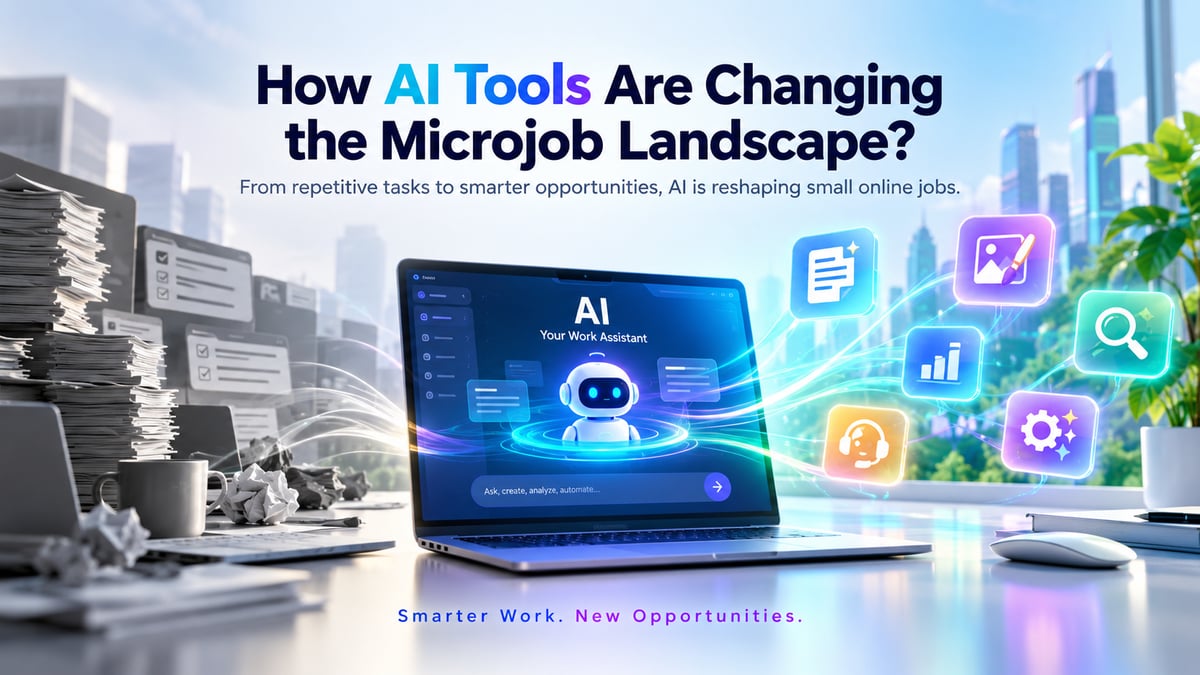
If you want to explore how AI tools are changing the microjob landscape, you are in the right place. Microjobs are no exception to being influenced by artificial intelligence (AI) which is transforming online work. With the help of AI-powered tools, jobs that once took a long time can now be completed more swiftly and accurately.
Microjobs in the age of AI offer freelancers, students, remote workers, and others seeking flexible online income both opportunities and challenges. AI may automate some repetitive jobs, but it is also increasing the need for human involvement and skill for organizing, testing, correcting, reviewing, and enhancing AI-generated solutions.
With a deeper grasp of AI and microjobs, workers can enhance their skills and discover better opportunities in the changing online work market. Research, data input, content authoring, testing, categorization, transcribing, image identification, and other digital jobs can all be impacted by AI, but without human intervention, accuracy and attention to detail cannot be guaranteed.
Will AI Replace Microjobs?
It can be a worldwide query for professionals that Will AI replace microjobs? The answer cannot be a simple yes or no, but it requires a proper evaluation of the available factors.
AI can surely automate several repetitive tasks like data entry, content writing, and transcription. AI introduction won’t remove microjob requirements, but it will only boost your productivity if you have humanizing skills. However, automation does not necessarily eliminate every job connected to those activities.
AI systems still need humans for tasks such as:
Reviewing AI-generated information
Checking factual accuracy
Proofread
Evaluating responses
Labeling data
Testing AI systems
Providing human feedback
Identifying inappropriate or misleading content
Following detailed client-specific instructions
These types of microjob may take a new shape rather than disappear completely and become obsolete from the market.
Growing AI Data Annotation Jobs
AI data annotation jobs are the most popular and growing jobs in the world of AI. Human workers can help prepare and evaluate these data with efficiency and accuracy which AI lacks.
The annotation job may include these tasks which individuals can look for their professional growth:
Labeling images
Categorizing text
Reviewing search results
Evaluating AI responses
Identifying objects in images
Checking sentiment in text
Comparing AI-generated answers
Transcribing or verifying audio
Classifying information
New Microjob Opportunities by AI
AI is not removing existing job opportunities, but it is redefining them into renewed opportunities which are not the usual ones. Some of these emerging opportunities include:
1. AI Response Evaluation
AI responses must be studied for relevance, applicability, clarity, relevance and precision. Responses can be compared by human evaluators to determine which are better.
2. AI Data Labelling
Workers can identify and arrange material required to train or evaluate AI systems.
3. AI Output Editing
AI-generated text may require human editing to improve clarity, tone, accuracy, and readability.
4. Image and Content Review
Digital information and images created by AI may require human review, classification and quality assurance.
5. AI Testing
Employees may be required to test AI products, find issues, assess answers, or offer user experience feedback.
6. Search and Information Evaluation
Some projects require people to assess whether search results, recommendations, or AI-generated information match a particular query or requirement.
How to Use AI Tools for Microjobs?
AI tools can help workers become more efficient in their existing microjobs and also excel in the future work.
A microjob user might use AI to:
Brainstorm ideas
Organize information
Summarize long documents
Improve grammar
Create initial content outlines
Analyze large amounts of text
Create checklists
Improve workflow organization
Identify potential errors
AI can be a collaborator for human workers rather than an automatic replacement to know how to use AI tools for microjobs. Thus, before submitting AI-assisted work, workers should review the output carefully for reliable and relevant results. AI can produce incorrect, outdated, repetitive, or misleading information.
Human Skills Are Becoming More Important!
AI can improve your speed of work and automate the process, but it can’t ensure quality of work. A client still requires someone who understands context, recognizes an unusual error, communicates clearly, and makes a sensible decision. The need for someone who has understanding ability is highly needed for relevance.
AI may categorize information incorrectly whereas human reviewers can identify and correct the mistake. This is why human intervention is likely to remain important across many areas of AI-assisted work.
How to Stay Competitive?
AI adaptability is essential for the upcoming competitive market where people can upgrade their growth strategies.
Microjob workers can stay competitive by:
Learning useful AI tools: Individuals need to be aware of and up to date with the AI tools that can help them implement it in the workflow.
Improving human skills: Individuals need to give emphasis on communication, judgment, research, and accuracy, with the help of these AI tools to practice and enhance themselves.
Checking AI output: AI-generated information is never correct, so it needs to be evaluated using the best AI tools for freelancers and microworkers.
Exploring AI-related microjobs: Individuals need to look for AI-proof online jobs like data annotation, AI evaluation, testing, and human feedback.
Following platform and client rules: If you want to work on new microjob opportunities created by AI, you need to check the platform guides to abide by the client rules.
Building a strong reputation: You need to develop accuracy, reliability, and consistent quality to remain valuable regardless of any upgrade.
Conclusion
Thus, now you have an idea of how AI tools are changing the microjob landscape. The microjob landscape is evolving, and some simple tasks may become increasingly automated with active human interference to boost productivity and growth.